Skip to content
UNESCO Bernina line · Switzerland · Italy

The Bernina Express & Red Train — your honest ticket guide

Same UNESCO route, same alpine views — two trains, very different tickets. Compare the panorama Bernina Express and the regional Trenino Rosso side by side and book at official partner prices.

  • All scenic routes
  • Honest comparison
  • Live partner prices
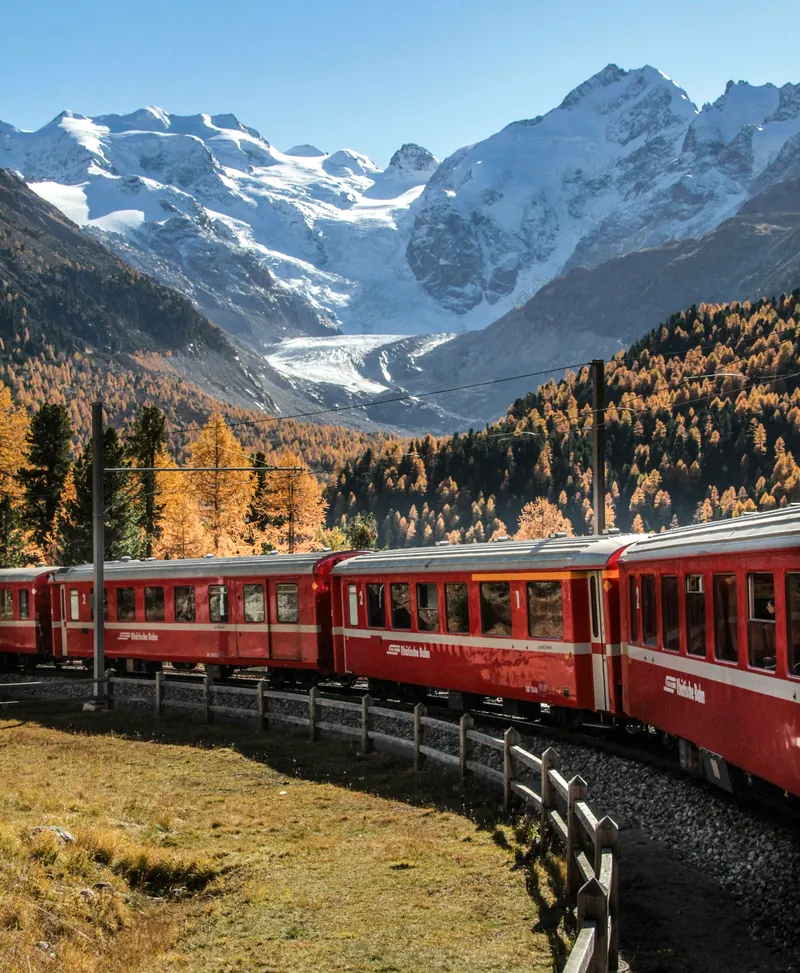
Red Bernina Railway train curving past the Morteratsch Glacier in autumn — Swiss Alps, UNESCO World Heritage line
Honest comparison
Live partner prices
2026 schedule
No markup

Which route is right for you?

The UNESCO Bernina line runs from Chur in eastern Switzerland over the Bernina Pass down to Tirano in northern Italy, with a branch to St. Moritz. Pick the section that fits your trip — every page below has tickets, the 2026 timetable, and an honest heads-up on what to expect.

Bernina Express or Red Train? The honest comparison

Two trains run on the exact same UNESCO Bernina tracks. The views are identical. The Bernina Express is the panorama-glass train with mandatory seat reservation, 1–3 daily departures and at-seat catering. The Red Train (Trenino Rosso) is the regional train: roughly hourly, no reservation needed, openable windows — and about half the price. Most travellers should take the Red Train unless the panorama roof and the reserved seat are worth the difference.

See the full comparison

The UNESCO Bernina railway

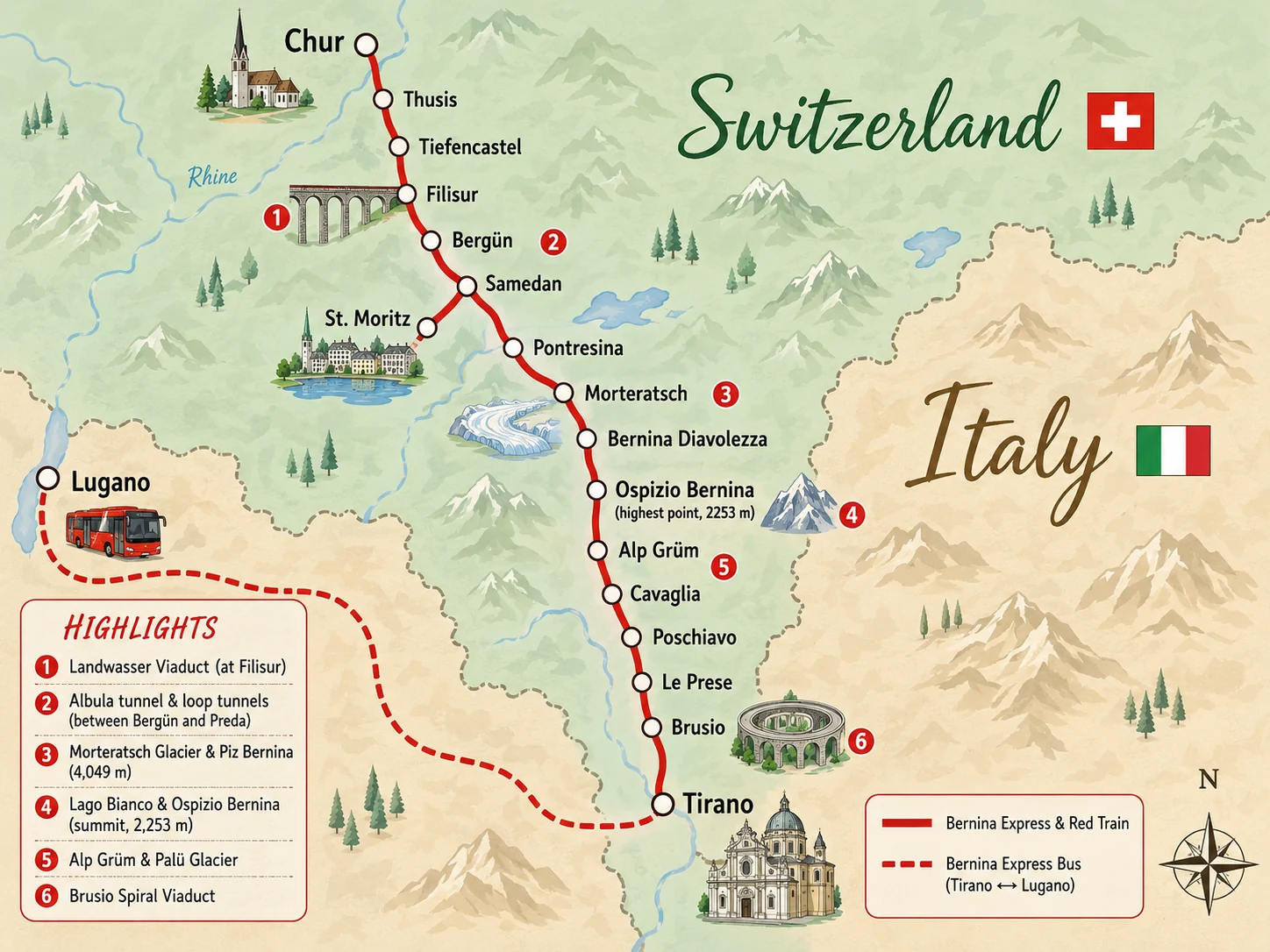
Illustrated map of the UNESCO Bernina railway from Chur via Samedan to Tirano, with the St. Moritz branch, the Bernina Express bus to Lugano, and six numbered route highlights
The UNESCO Bernina railway — Chur to Tirano via the Bernina Pass, with the St. Moritz branch and the connecting bus to Lugano.

What is the Bernina Railway?

The Bernina Railway, operated by Rhätische Bahn (RhB), is one of the most spectacular mountain railways in Europe and the highest-altitude rail crossing of the Alps that does not use a tunnel. Together with the connecting Albula line from Chur to St. Moritz, it has been a UNESCO World Heritage Site since 2008 — recognised both for its scenic value and as a feat of engineering completed in 1910.

The route in numbers

The full Bernina line covers 144 km between Chur (585 m) and Tirano (430 m), crossing the Ospizio Bernina pass at 2,253 m — the highest point on the line. It includes 196 bridges, 55 tunnels and gradients up to 7 % without cog-rail assistance. The most-booked section is the 2 h 15 segment between Tirano and St. Moritz, which captures the headline scenery: the Brusio Spiral Viaduct, Lago di Poschiavo, Alp Grüm, Lago Bianco at the summit, and the descent through Morteratsch with views of the Piz Bernina massif.

Two trains, one route

Two very different trains share the same UNESCO tracks. The Bernina Express is the curved-glass panorama train with reserved seating, an audio guide and at-seat catering — premium comfort with limited daily departures and a mandatory seat reservation booked separately from the ticket. The Red Train (Trenino Rosso) is the standard regional service that runs roughly hourly: normal carriages, no reservation, openable windows for photos, and about half the price. Same views from both. Travellers usually pick based on whether they want the panorama experience or the flexibility of an all-day ticket.

Route highlights

On the Albula section (Chur to St. Moritz), the line crosses the Landwasser Viaduct — a curved limestone arch that emerges directly from a tunnel — and the Solis Viaduct. On the Bernina section (St. Moritz to Tirano), the Brusio Circular Viaduct south of Poschiavo lets the train spiral down to gain altitude on an open stone arch. Between Alp Grüm and Ospizio Bernina, the train hugs the shore of glacier-fed Lago Bianco, with the dark Lej Nair on the opposite side — these are the European watershed and the photographic centrepiece of the line.

Year-round operation, 2026

Both trains run all year. Summer high season is 2 May to 25 October 2026 with up to 3 daily Bernina Express departures. Winter operates a reduced schedule. From 29 October to 13 November 2026 the Bernina Express is re-routed via the Vereina tunnel due to engineering works on the Bernina Pass — the train still runs with panorama coaches but skips the headline scenic section. The Red Train is not affected by the re-route.

Travelling from Milan? Skip the planning

If you are based in Milan and only have one day, a guided coach + Bernina-train + return tour is the easier choice. Five operators compete on this segment — we compare them side by side on group size, which train you actually ride, whether Lake Como is included, and how the day fits together. Most depart around 06:30 from Stazione Centrale and return around 20:30.

Compare Milan day trips

Before you book: 5 things to know

01

Bring your passport or ID

The line crosses the international border between Italy and Switzerland. Random ID checks happen, especially in the summer high season.

02

Same route, same views — really

Both trains share the same tracks. Booking the Red Train does not mean a worse view. The Bernina Express adds the panorama roof, at-seat catering and a reserved seat — not a different route.

03

Bernina Express reservation is mandatory and separate

On Rhätische Bahn you buy the train ticket and the seat reservation separately. Reservation costs CHF 32 year-round for Tirano ↔ St. Moritz, CHF 40 or CHF 44 for the full Chur ↔ Tirano route depending on season.

04

Book direct with RhB for the best price

The official Rhätische Bahn site has the lowest fares for every route. EUR-priced resellers add a 20–35 % premium for currency conversion, mobile vouchers and free cancellation — useful if you need flexibility, expensive if you do not.

05

A day trip works — round-trip in about 5 hours

Tirano ↔ St. Moritz is the most popular section precisely because it fits in a day with time to walk around at the other end. A Red Train round-trip ticket is valid all day on any train in the same direction.

About the Bernina Railway

Where exactly does the Bernina Railway run?
The Bernina line runs 61 km between St. Moritz and Tirano (Italy), crossing the Bernina Pass at 2,253 m. It connects in St. Moritz to the Albula line, which runs another 89 km from St. Moritz to Chur in eastern Switzerland. The full Chur ↔ Tirano route is 144 km. The Bernina Express panorama train covers the full route; the Red Train runs the Bernina section only.
Where should I book my ticket?
For the cheapest price and the best availability, book directly with Rhätische Bahn at rhb.ch in Swiss francs. The official site is available in English, German, Italian and French. If you prefer to pay in EUR and want free cancellation up to 24 h before departure, EUR-priced resellers like GetYourGuide and Headout sell the same tickets at a 20–35 % premium.
When is the best time of year to go?
Late May to mid-October has the most reliable weather and the fullest schedule, but it is also the busiest — book reservations weeks in advance. Late September and early October combine fewer crowds with autumn colour. Winter (December to March) is dramatic with snow on the Bernina Pass, but the schedule is reduced and some travellers find the long ride less varied with frozen lakes.
Which side of the train should I sit on?
Coming from Tirano, sit on the right side for the Brusio Spiral Viaduct and Lago di Poschiavo. From St. Moritz, sit on the left for the same views. On the Bernina Express, the panorama roof means the difference is smaller — but you still get the headline angles from the correct side.
Is it worth doing with kids?
Yes — the scenery, the spiral viaduct and the high mountain pass are unusually engaging for children, and the Red Train carriages with openable windows often work better for kids than the sealed panorama coaches. Children under 6 travel free; ages 6 to 16 pay half the adult fare.
Should I do it on my own or take a guided tour?
If you are based locally or comfortable with European trains, doing it on your own is roughly 30 % cheaper and gives you full flexibility on timings. If you are starting from Milan and only have one day, a guided day trip handles the coach to Tirano, the Bernina train, and the return as one package — which is why these tours absorb most of the booking volume in this region.

Ready to plan your trip?

Compare both trains side by side, see the 2026 timetable and CHF fares, and book directly with the official operator — at the lowest possible price.